

If you want to know whether your brand appears in ChatGPT answers, Google AI Overviews, or other AI-powered search experiences, traditional SEO rankings only tell part of the story. You also need to understand which brands AI platforms mention, which sources they cite, and where your competitors are gaining visibility.
That is the problem Indexly aims to solve.
Indexly combines AI search visibility tracking, traditional SEO tools, content optimization, indexing workflows, and traffic analytics in one platform. Instead of simply measuring where a website ranks in Google, it helps businesses investigate how AI engines describe their brands and identify opportunities to improve their online presence.
But is Indexly worth paying for? Does it offer enough value for smaller websites, or is it better suited to agencies and growing marketing teams?
This Indexly review examines its features, pricing, potential benefits, limitations, and alternatives to help you decide.
Disclosure: This article is based on publicly available product information. It is not a claim of independent hands-on testing. Pricing and features may change, so check Indexly's official website before subscribing.
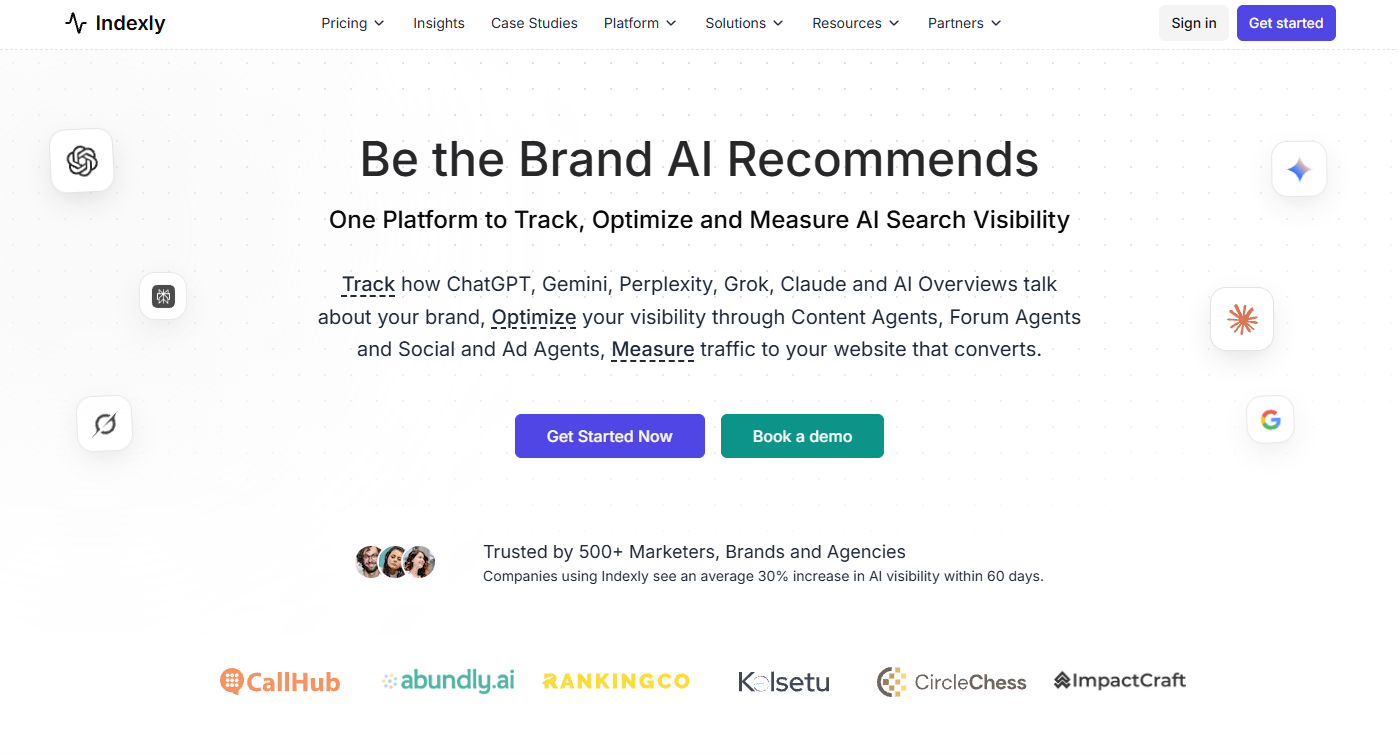
Indexly is worth considering if your business needs to monitor brand visibility across AI search platforms while managing SEO, content production, and traffic measurement in one place.
Its main differentiator is the combination of monitoring and optimization workflows. Many AI visibility tools focus primarily on reporting where a brand appears. Indexly also offers tools designed to help teams create and improve content, monitor online discussions, and measure traffic from AI sources.
However, the platform may be more than a small website needs. If your primary goal is to submit a few URLs for indexing or check basic keyword rankings, a more focused tool may be more economical.
Indexly may be a good fit for:
SaaS companies that depend on organic discovery.
SEO agencies managing multiple clients.
Marketing teams exploring generative engine optimization (GEO).
Content-led businesses that want to measure AI-referred traffic.
Brands that need both traditional SEO and AI visibility workflows.
It is less compelling for users who need only a basic indexing utility or expect software alone to guarantee mentions in AI-generated answers.
Indexly is an SEO and AI search visibility platform designed to help businesses track, improve, and measure their online presence.
Its AI visibility tools monitor how platforms such as ChatGPT, Gemini, Perplexity, Claude, Grok, and Google AI Overviews discuss brands in response to tracked prompts. Depending on the features and plan used, the platform can also analyze sentiment, citations, competitor visibility, and traffic from AI engines.
The broader product includes technical SEO audits, indexing tools, content generation and optimization, social and community workflows, and analytics.
This makes Indexly different from a tool that focuses exclusively on keyword positions or URL submission.
Suppose someone asks an AI assistant, “What are the best project management tools for a small agency?”
The response may mention several competing brands and cite sources that influenced its answer. If your business is absent, you may miss an opportunity to enter that buyer's consideration set—even if your website has useful content.
AI search visibility tools help you investigate questions such as:
Does an AI platform mention my brand for relevant queries?
Which competitors appear in the same answers?
Which pages or websites are cited?
Does the AI describe my brand accurately?
Are my visibility metrics changing over time?
Indexly is designed to make these observations more systematic than checking a handful of prompts manually.
Importantly, AI answers can change between queries and over time. Tracking provides a useful monitoring framework, but it does not guarantee that every user will see the same answer or that improved visibility will automatically produce sales.
AI visibility tracking is one of Indexly's central features.
Instead of focusing only on traditional search rankings, users can track selected prompts across supported AI platforms and monitor whether their brand appears in the responses.
This is particularly useful for queries with commercial intent, such as:
Best software for a specific industry.
Alternatives to a competing product.
Comparisons between two providers.
Recommendations for a particular business need.
For example, a SaaS company might track prompts such as “best CRM for small businesses” or “alternatives to [competitor].” The results can help the marketing team identify gaps in its AI search presence.
Why it matters: Teams can turn AI visibility from an occasional manual check into a recurring monitoring process.
What to keep in mind: The quality of the findings depends on the prompts selected, the AI engines tracked, the measurement methodology, and the frequency of updates. A visibility score is a diagnostic metric, not proof of revenue impact.
Being mentioned by an AI platform and being cited as a source are related but different outcomes.
A brand might appear in an answer without receiving a direct link. In other cases, an AI response may cite a third-party article, comparison page, discussion, or company website.
Indexly offers citation analysis and competitor benchmarking intended to show where brands appear, which sources are associated with AI responses, and where competitors may have an advantage.
These insights can inform content planning. If competing brands repeatedly appear in relevant answers and are supported by specific sources, you can investigate whether your own website lacks useful comparisons, detailed explanations, original research, or relevant third-party coverage.
The practical benefit: Rather than publishing more content indiscriminately, your team can prioritize gaps that appear relevant to its target audience.
Citation analysis should still be treated as evidence for further investigation, not a complete explanation of how an AI model generated a response.
AI visibility does not replace traditional SEO.
Websites still need accessible pages, clear information architecture, useful content, sensible internal links, and sound technical foundations. Indexly includes SEO-related features such as website audits, on-page checks, keyword opportunities, backlink analysis, page-speed insights, and AI-readiness checks.
These tools can help teams identify issues that interfere with crawling, content discovery, or page quality.
For a website that is already investing in AI search visibility, combining technical diagnostics with AI tracking may reduce the need to move between separate dashboards.
However, an audit score is not a substitute for prioritization. Not every technical issue has the same impact, and correcting every recommendation does not guarantee higher rankings.
Indexly also offers indexing workflows intended to submit new or updated pages to supported search engines and monitor submission activity.
This can be useful for publishers that regularly add pages, ecommerce sites with changing catalogs, or agencies managing many URLs.
The distinction between submission and indexing is important. Submitting a URL tells a search engine about a page; it does not guarantee that the page will be crawled, indexed, or ranked.
Indexly's own indexing information acknowledges that Google ultimately decides whether to index a submitted page. Website quality, crawlability, content value, and search-engine policies still matter.
If you need only occasional URL submission, compare the value of a paid platform against the free tools available directly from search engines.
Indexly offers content workflows designed to discover topics, generate articles, optimize existing pages, and refresh older content.
Its Auto-Pilot offering is positioned around a broader process: identify SEO keywords and AI-related queries, organize content opportunities into a publishing calendar, create articles, and connect publishing with supported content management and indexing workflows.
For a content team, this may help reduce repetitive research and production work.
Nevertheless, AI-generated content still needs editorial oversight. Before publishing, review factual claims, sources, originality, brand voice, search intent, and whether the article provides something useful beyond information already available elsewhere.
Publishing more pages is not inherently a successful SEO strategy. Quality, relevance, differentiation, and reader satisfaction remain essential.
Indexly also provides features intended to help brands identify relevant discussions and build a more consistent professional and community presence.
This matters because buyers do not discover brands only through company websites. They may research products through community discussions, professional posts, reviews, and comparison articles.
These workflows can help marketing teams find relevant topics and prepare responses or content. They should not be treated as a shortcut to artificial engagement.
On platforms such as Reddit, contributions should be genuinely useful, follow community rules, and disclose commercial relationships when appropriate. Repetitive promotional posts can undermine trust rather than build authority.
Monitoring visibility is more useful when you can connect it to website visits and business outcomes.
Indexly describes analytics features that bring together traditional search performance and traffic referred by AI platforms. This can help teams investigate whether AI-related discovery is associated with visits to their websites.
For meaningful measurement, consider tracking:
Organic search clicks and impressions.
Visits attributed to AI referral sources.
Landing pages receiving those visits.
Engagement and conversion rates.
Qualified leads or sales, where attribution is available.
Attribution has limitations: referral data may not capture every AI-influenced visit, and a rise in traffic does not necessarily mean a rise in revenue. Combine platform reports with your analytics and conversion data wherever possible.
Indexly's official pricing page currently advertises an AI Visibility plan at $99 per month. The listed plan includes two sites, 100 tracked prompts, three selectable AI models, two countries, daily tracking, brand sentiment, hallucination detection, and competitor analysis.
The pricing page also advertises a 7-day free trial and 50% off the first month. Promotional terms and plan availability can change, so verify the current offer before signing up.
Indexly has also published pricing for other plan categories, including agency-oriented packages and broader SEO/content workflows. The final cost depends on the package and capabilities you need.
| Pricing consideration | What to check |
|---|---|
| Number of websites | Make sure the plan covers your domains and client projects |
| Tracked prompts | Estimate how many buyer queries you need to monitor |
| AI models and countries | Confirm the engines and markets relevant to your audience |
| Content features | Check article generation, optimization, and automation limits |
| Team and agency tools | Review collaboration, reporting, and white-label requirements |
| Billing and promotions | Confirm monthly versus annual terms and any trial conditions |
You can check current plan details on the official Indexly pricing page.
The value depends on how frequently you use the platform and how much time it saves.
For an agency or SaaS marketing team that regularly tracks competitors, audits content, and reports on AI search visibility, a consolidated platform may justify its subscription cost.
For a solo blogger who publishes a few articles per month, the same price may be difficult to justify unless AI visibility tracking is a specific business priority.
Before subscribing, identify the decisions you want the data to support. If the insights do not lead to concrete improvements in content, visibility, traffic, or reporting, the subscription may not provide sufficient value.
Combines multiple workflows: AI visibility, technical SEO, content optimization, indexing, and analytics are available within one platform.
Tracks AI-specific metrics: Prompt-level mentions, sentiment, citations, and competitor presence can reveal opportunities that traditional ranking reports may miss.
Supports content operations: Content tools can help teams organize production and optimization.
Useful for agencies and growing teams: Multiple websites, prompt tracking, and reporting capabilities may support ongoing client work.
Offers a trial: The official pricing page advertises a seven-day free trial, subject to the terms presented at signup.
May be expensive for basic needs: A user who only wants to submit URLs or check a small number of keywords may not need the broader platform.
Visibility is not guaranteed: Tracking and optimization cannot force AI platforms to mention or cite a brand.
Requires thoughtful setup: Poorly selected prompts or irrelevant competitor comparisons can make reports less actionable.
AI content needs review: Automated drafts can contain errors, generic language, or unsupported claims.
Results need business context: More mentions or citations do not necessarily translate into qualified traffic, leads, or sales.
SaaS businesses often compete for queries such as “best tool for [use case],” “alternatives to [product],” and “X vs. Y.”
Indexly may help marketing teams monitor those prompts, identify competitors appearing in answers, and plan content around gaps in coverage.
Agencies managing multiple clients may benefit from a single workflow for AI visibility monitoring, technical SEO, content optimization, and reporting.
Before committing, check the limits on websites, prompts, team access, reports, and white-label features. Those details can determine whether a plan fits the agency's operating model.
Publishers that produce content at scale may find the combination of content planning, optimization, and indexing workflows useful.
The key question is whether the platform helps the team publish more valuable content—not merely more content.
A smaller site can still benefit from AI visibility data, especially if it relies on organic discovery for leads or affiliate commissions.
However, the cost may be difficult to justify if the site has little traffic, no established content strategy, or no clear way to act on the insights. Start by identifying your highest-value use case and compare it against lower-cost alternatives.
Traditional SEO platforms generally focus on areas such as keyword rankings, backlinks, technical audits, and competitor research. AI visibility tools add another layer: whether a brand is mentioned or cited in AI-generated responses.
Indexly attempts to bridge these areas by combining AI search tracking with SEO and content workflows.
That broader scope can be helpful if you want one place to monitor both conventional search and AI discovery. However, a specialized SEO platform may offer deeper functionality in a particular area.
The best choice depends on your workflow:
Choose a traditional SEO platform if keyword research, backlink analysis, and rank tracking are your main priorities.
Consider an AI visibility specialist if you primarily need detailed prompt tracking and citation analysis.
Consider Indexly if you want to monitor AI visibility and also work on SEO, content, indexing, and analytics from a shared platform.
Do not assume that a broader feature list automatically means better results. Compare the depth of each feature, reporting quality, integration requirements, and the time needed to use the platform effectively.
Before buying Indexly, compare it with tools that address your most important need.
Consider researching Profound if your priority is enterprise-oriented AI search visibility and understanding how brands appear across AI answer experiences. Compare supported platforms, prompt coverage, reporting, and pricing before deciding which solution fits your organization.
Peec AI is another option to investigate for AI search analytics and brand visibility monitoring. It may be relevant if tracking and competitor insights matter more to you than a broad set of SEO and content-production features.
Established SEO platforms are worth considering when keyword research, backlink analysis, technical audits, and traditional organic search remain your main priorities. Review their current AI-related capabilities as well as their core SEO features.
If your immediate goal is to understand how your website performs in Google Search, start with Google Search Console. It provides first-party search performance information without requiring an additional paid subscription.
It is not a complete replacement for AI visibility monitoring, but it can be a sensible foundation for a smaller website.
Comparison tip: Evaluate alternatives using the same prompts, websites, countries, and reporting requirements. That makes it easier to compare their practical usefulness rather than relying on marketing claims.
Indexly presents itself as an SEO and AI search visibility platform with public product, feature, and pricing pages. Its stated capabilities include prompt tracking, AI citation analysis, content workflows, indexing, and analytics.
That establishes what the company says it offers, but it does not independently prove that the platform will improve every customer's visibility or business performance.
Before paying, use the trial if available and test a realistic workflow:
Add a website and select relevant competitors.
Configure prompts that reflect actual customer questions.
Review the citations and visibility reports for usefulness.
Test a technical SEO or content workflow.
Check whether the resulting recommendations are specific enough to act on.
Verify what the subscription includes and how billing works.
This approach will tell you more about product fit than a generic promise of improved AI visibility.
Indexly is an option worth evaluating for businesses that want to connect traditional SEO with the growing need to understand brand visibility in AI-generated answers.
Its strongest appeal is the breadth of its workflow: monitor prompts and citations, analyze competitors, improve content, manage indexing tasks, and examine traffic in one platform.
The main trade-off is complexity and cost. Not every website needs a comprehensive platform, and no SEO or AI visibility tool can guarantee rankings, citations, leads, or sales.
If AI search visibility is becoming a meaningful part of your marketing strategy, use the trial to test whether Indexly's data leads to decisions you would not otherwise make. If your needs are limited to basic indexing or conventional SEO reporting, compare simpler alternatives first.
Ready to evaluate Indexly? Review the current features, pricing, and trial terms on the official website before choosing a plan.
Indexly is designed to track and improve a brand's visibility across AI search platforms while also providing SEO audits, content tools, indexing workflows, and analytics.
Yes. Indexly lists ChatGPT among the AI platforms it supports for brand and prompt visibility tracking. The exact models, limits, and tracking frequency depend on the available plan.
The official pricing page currently advertises an AI Visibility plan at $99 per month. Other plans and agency packages may have different prices and limits. Check the official pricing page for current details.
The official pricing page advertises a seven-day free trial. Check the signup page for current eligibility, terms, and any promotional conditions.
No. Indexly can help monitor visibility and identify optimization opportunities, but it cannot guarantee that AI platforms will mention, cite, or recommend your website.
No. AI visibility and traditional SEO are complementary. Technical website health, useful content, relevant keywords, and credible sources remain important even when you monitor AI-generated answers.
It may be suitable for beginners who have a clear goal and are willing to learn the platform. However, the breadth of its features and subscription cost may be unnecessary for users who only need basic SEO or indexing tools.
Potential alternatives include Profound and Peec AI for AI visibility research, Semrush or Ahrefs for broader SEO workflows, and Google Search Console for Google search performance. The best alternative depends on your budget and the features you need.