

AI coding tools can make developers dramatically faster.
They can also create a new problem: more code moving through your development pipeline means more code that needs to be reviewed.
That is where CodeRabbit positions itself.
Rather than acting as another AI coding assistant that writes code for developers, CodeRabbit is designed to provide an independent review layer around software changes. It analyzes pull requests, applies team-specific standards, identifies potential bugs and security issues, and increasingly extends those controls beyond the pull request itself.
For individual developers, that may sound like a productivity tool.
For an enterprise engineering organization, the more interesting question is different:
Can CodeRabbit become a reliable quality and governance layer across hundreds of developers and repositories?
This CodeRabbit Enterprise review looks at its enterprise features, AI code review capabilities, security, deployment options, integrations, pricing, customer feedback, limitations, and who should consider it.
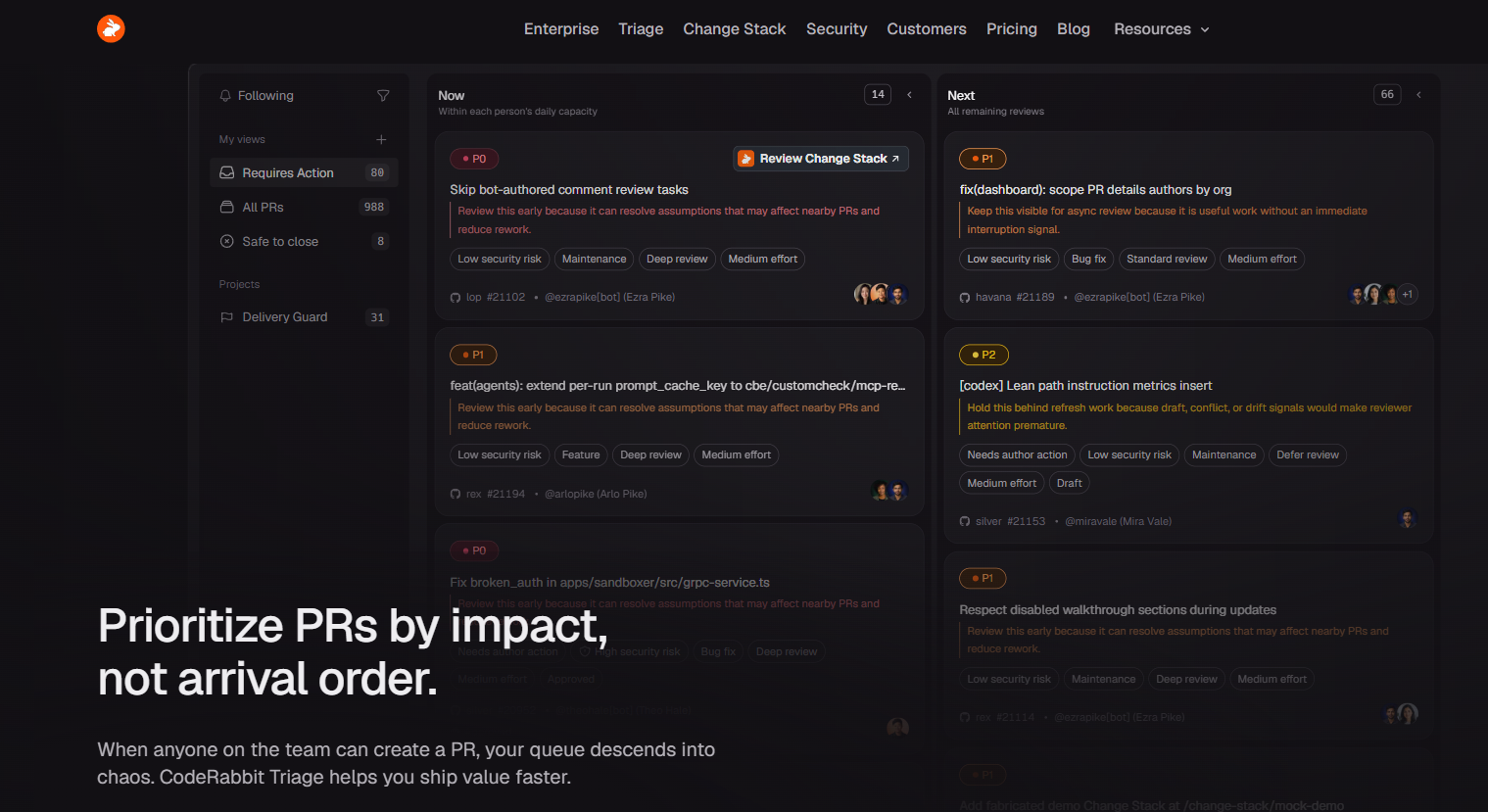
CodeRabbit Enterprise is designed for organizations that want centralized AI-assisted code review and governance rather than simply another coding assistant.
Its strongest enterprise differentiators are:
The biggest question is not whether CodeRabbit can review code.
It clearly can.
The more important question is how much value your organization gets from standardizing that review layer across teams without creating excessive review noise, false positives, or another administrative system to manage.
Current third-party reviews are generally positive about review quality and ease of integration, but some users report irrelevant suggestions, excessive comments, UI/performance issues, and concerns around usage limits.
For an enterprise evaluating CodeRabbit, I would therefore treat it as a candidate for a controlled pilot, not something to deploy organization-wide based solely on marketing claims.
CodeRabbit is an AI-powered software development platform focused on code review and engineering change management.
The company's original use case was automated pull-request review.
Its current enterprise positioning goes considerably further.
CodeRabbit describes the platform as an independent control layer that can evaluate software changes across repositories, coding agents, development environments, and security workflows.
That distinction matters.
A coding assistant helps a developer create code.
CodeRabbit is intended to provide an additional system that reviews and governs changes.
The idea is particularly relevant when an organization uses several AI coding tools.
Instead of asking which AI assistant generated a piece of code, an engineering organization can apply the same review policies to the resulting pull request.
That gives CodeRabbit a somewhat different position from products focused primarily on AI-assisted code generation.
At its core, CodeRabbit automatically reviews pull requests.
But the enterprise product layers additional context and governance around that process.
Its current platform includes features such as:
The goal is not simply to generate more comments.
It is to provide reviewers with more context before they approve a change.
A traditional pull-request review often starts with the diff.
The reviewer looks at changed lines and tries to understand what those changes mean in the context of the larger application.
That becomes difficult when repositories are large or when a pull request touches multiple components.
CodeRabbit attempts to solve this by looking beyond the immediate diff.
Its enterprise materials describe contextual signals including:
The platform also uses code-graph and repository-level analysis to reason about relationships between components.
This is important because many meaningful software defects are not obvious from one changed line.
A change may alter behavior somewhere else through a shared dependency, API contract, database interaction, authorization path, or configuration.
The broader the context available to the reviewer, the more useful an automated review can potentially become.
“Context-aware” is one of CodeRabbit's central product claims.
In practical terms, the objective is to reduce the limitations of a simple line-by-line AI review.
For example, imagine a developer changes an authorization function.
A basic static check might recognize a suspicious condition.
A repository-aware system could potentially understand:
That doesn't mean CodeRabbit will always reach the correct conclusion.
AI-generated review comments still need human judgment.
But the architectural context is one of the more important reasons an enterprise might consider CodeRabbit rather than treating it as a simple AI linting tool.
Security is arguably the most important part of the enterprise buying decision.
Code review tools have access to source code, which means organizations need to understand how that code is handled before connecting production repositories.
CodeRabbit says its enterprise offering is built around security and privacy controls including encryption, SOC 2 Type II controls, self-hosting options, access controls, and auditability.
The company also provides enterprise-specific contractual documents, including a Master Services Agreement, Data Processing Addendum, Service Level and Support Agreement, and Self-Hosted Addendum.
For an enterprise security team, that is more meaningful than a generic “enterprise-ready” badge.
However, certification and contractual controls do not eliminate the need for your own vendor assessment.
Your security team should still ask:
Those questions should be answered from the current security documentation and contract rather than inferred from marketing copy.
Self-hosting is one of the biggest reasons an enterprise security team may take CodeRabbit seriously.
Enterprise customers can choose a self-hosted deployment option.
This matters for organizations with strict requirements around source-code residency, network isolation, regulatory controls, or internal infrastructure.
CodeRabbit also introduced a Reverse Tunnel option in 2026 for private-network environments involving GitHub Enterprise Server, self-managed GitLab, and Gerrit.
The architecture allows a connector inside the customer's network to establish an outbound encrypted connection rather than requiring an inbound connection to the internal Git environment.
For organizations with heavily restricted networks, this can be a meaningful deployment consideration.
It does not automatically mean self-hosting is the right choice, though.
Self-hosting transfers more operational responsibility to the customer.
You need to consider:
So the comparison is not simply:
SaaS = less secure
versus
Self-hosted = more secure
The actual question is which deployment model fits your organization's security architecture and operational capabilities.
Enterprise environments rarely want every developer to have the same permissions.
CodeRabbit's current Enterprise offering includes:
The API exposes organization and user management, role management, metrics, learnings, security scans, and audit logs.
This matters because enterprise adoption isn't only about whether the AI can review code.
Administrators need to answer questions such as:
An audit trail becomes particularly valuable when AI-generated recommendations become part of a formal software-development governance process.
CodeRabbit has also expanded into dedicated application-security analysis.
Its 2026 Security product introduces a workflow built around:
Map → Hunt → Verify → Fix
The idea is to analyze the application beyond the changed lines in a pull request.
CodeRabbit describes its AI Deep Scan as analyzing committed source code and infrastructure configuration across an entire repository, while PR Findings focus on security issues associated with incoming changes.
This distinction is useful.
A conventional PR review mainly asks:
“Is this proposed change safe?”
Continuous security analysis can also ask:
“Does the existing codebase contain a security problem that isn't part of today's pull request?”
Those are different problems.
For enterprise engineering teams, having both views can reduce the risk of treating the pull-request process as the only security checkpoint.
CodeRabbit isn't positioned as a complete replacement for every security-testing system.
Instead, the platform integrates with linters and SAST tools and uses their signals as additional context.
CodeRabbit says its platform incorporates signals from more than 40 integrated linters and SAST tools.
This can be useful because AI review and deterministic security tools have different strengths.
A practical enterprise architecture may look like:
Developer → AI coding assistant → Pull request → CodeRabbit + SAST/Linters → Human review → CI/CD → Production monitoring
The goal is not necessarily to replace existing controls.
It is to connect them into a more context-rich review workflow.
Enterprise adoption becomes much easier when the product fits into tools developers already use.
CodeRabbit supports major Git-based development environments and offers integrations across Git platforms, IDEs and CLI workflows.
Its enterprise offering also highlights integrations with tools such as:
The company says its enterprise platform can use engineering context from systems such as Jira and Confluence through MCP.
That is potentially important for organizations where the definition of “correct code” depends on more than the source code itself.
For example, a ticket may contain the business requirement that determines whether an implementation is correct.
Engineering leaders don't only want individual review comments.
They need organizational visibility.
CodeRabbit provides metrics and reporting around areas such as:
Its public API also exposes review and review-comment metrics.
This creates the possibility of measuring trends rather than relying entirely on developer anecdotes.
For example, an engineering organization could potentially monitor:
The important caveat is that these metrics should be interpreted as engineering signals, not as automatic proof that AI improved software quality.
A high number of findings could mean better detection.
It could also mean excessive noise.
CodeRabbit's Enterprise plan uses custom annual pricing.
The current pricing page does not publish a standard Enterprise dollar amount.
Instead, Enterprise includes the Advanced feature set plus enterprise controls and services.
These currently include:
The pricing page also shows that Enterprise has higher review limits than the lower tiers and allows enterprise-specific usage arrangements.
This means you should not compare CodeRabbit Enterprise using a simple per-developer sticker price.
The real enterprise cost may include:
When speaking with sales, ask for a pricing model based on your actual PR volume and developer population rather than simply multiplying a public individual plan price.
This is an important comparison.
The current Advanced plan already includes:
So an organization shouldn't automatically buy Enterprise simply because it wants more sophisticated AI review.
Enterprise becomes more relevant when the organization needs the governance and deployment layer around that functionality.
The difference is essentially:
Advanced = deeper AI review
Enterprise = deeper AI review + enterprise administration, security, deployment and support
That distinction can prevent overbuying.
These products overlap in AI-assisted development, but their primary roles are different.
GitHub Copilot is primarily associated with helping developers write and modify code.
CodeRabbit's core positioning is independent review and governance of changes.
That makes the two potentially complementary.
For example:
Copilot generates code → CodeRabbit reviews the resulting PR
This becomes especially relevant as organizations adopt multiple coding agents.
An independent review layer can apply the same organizational standards regardless of which AI tool generated the code.
Traditional human review remains valuable.
Humans understand:
AI can instead provide another review pass at scale.
That makes the strongest enterprise case for CodeRabbit less about replacing engineers and more about changing how engineers spend their review time.
A human reviewer can focus on questions like:
“Is this the right product decision?”
while automated review handles more repetitive questions like:
“Could this null value propagate here?”
“Does this change violate the team's established pattern?”
“Is this dependency likely to affect another component?”
The two roles are complementary.
Third-party reviews provide some useful evidence.
G2 currently shows CodeRabbit at 4.4/5 across 142 reviews.
Common positive themes include:
Recent G2 reviews also mention that CodeRabbit can make pull requests easier to understand through summaries and diagrams.
Gartner Peer Insights currently lists CodeRabbit at 4.2/5 from 21 ratings.
Reviews there similarly mention detailed PR insights, while some reviewers point to administrative limitations and the need to improve granular user management.
These ratings are useful signals, but they are not substitutes for a technical evaluation against your own repositories.
This is where an enterprise buyer should pay close attention.
G2's aggregated review analysis identifies several recurring criticisms:
Recent marketplace reviews describe a similar pattern: users appreciate catching bugs and edge cases, but sometimes need to filter technically valid yet low-priority comments.
That is a critical issue for enterprise deployment.
AI review quality isn't just:
How many bugs did it find?
It's also:
How many useful findings did it produce relative to the attention required to process them?
If developers start ignoring CodeRabbit because every PR generates too many low-value comments, the theoretical benefit can disappear.
Usage limits deserve particular attention during procurement.
The current public pricing page specifies rate limits by plan and says reviews beyond included limits can be billed according to the applicable usage model.
Enterprise usage is arranged with the account team.
This is worth clarifying in a sales conversation because enterprise organizations can generate a very large number of pull requests.
Ask for:
This matters because a tool that works well for 20 developers can have a very different cost profile for 500 developers.
No.
That would be the wrong way to deploy it.
AI code review can identify issues humans miss, but it can also produce false positives or misunderstand requirements.
CodeRabbit's own enterprise positioning emphasizes helping human reviewers rather than eliminating engineering judgment.
The best deployment model is therefore:
AI review first → human review for judgment → automated CI/security checks → merge
rather than:
AI review → automatic merge everything
For high-risk code, human approval should remain an explicit control.
There is enough public evidence to justify putting CodeRabbit through a formal enterprise security evaluation.
The company reports SOC 2 Type II controls and provides enterprise contractual/security documentation. Enterprise also offers self-hosting, SSO, RBAC, audit logs and specialized network options.
But “SOC 2 compliant” should not be interpreted as “automatically approved for every organization.”
A bank, healthcare provider, government organization and SaaS startup may have completely different requirements.
Before deployment, security teams should review:
That is standard vendor due diligence for any AI system that processes proprietary source code.
CodeRabbit Enterprise is most relevant to organizations with:
It becomes particularly interesting when the organization has moved beyond:
“Can AI review my pull request?”
and is asking:
“How do we enforce consistent review standards across hundreds of repositories?”
Enterprise may be excessive for:
For those users, CodeRabbit's lower-tier plans may provide enough functionality.
The current public plans include Essentials, Team and Advanced before Enterprise, with Enterprise reserved for custom enterprise controls and deployment requirements.