

Finding, reading, and synthesizing research papers can take hours. Even after locating relevant sources, researchers still need to compare findings, identify disagreements, organize references, and make sure their conclusions are supported by evidence.
Anara is an AI research workspace designed to help with these tasks. It can search research materials, answer questions about uploaded documents, generate source-linked responses, and help users turn their findings into organized writing.
But is Anara worth paying for? Does it make academic research easier without sacrificing accuracy, and which subscription plan offers the best value?
In this Anara review, we examine its main features, pricing, document limits, potential benefits, limitations, privacy considerations, and alternatives. The goal is to help you decide whether it fits your research workflow before committing to a paid plan.
Editorial disclosure: This review is based on publicly available product information and documentation. It does not claim independent hands-on testing or independently reproduce Anara's published benchmark results.
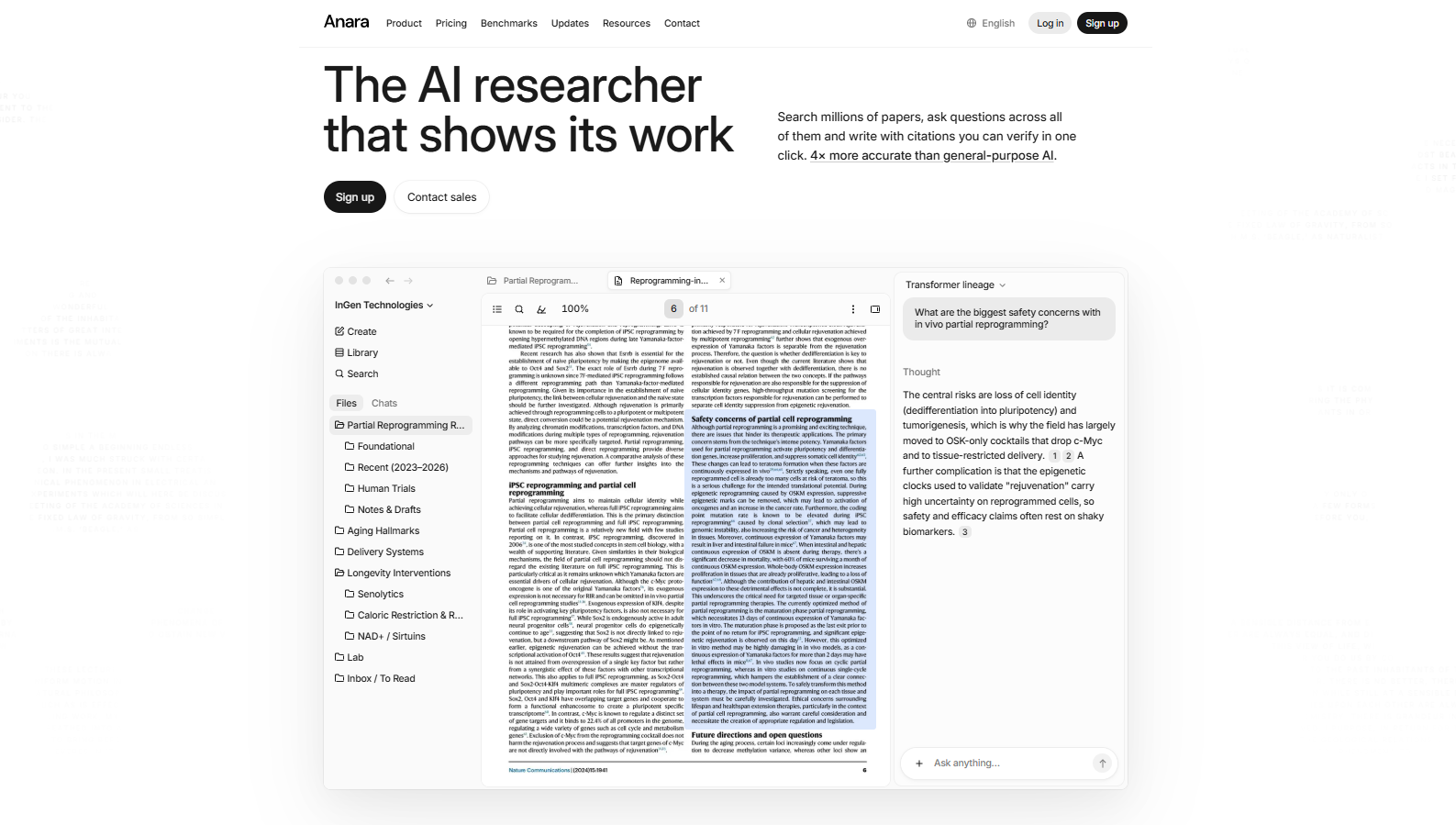
Anara is an AI workspace for scientific and academic research. Rather than functioning only as a general-purpose chatbot, it combines a document library, AI research assistant, and writing environment.
The platform is designed to help users work with scientific papers, PDFs, notes, and connected sources. Its advertised capabilities include searching a research library, finding academic literature, answering questions with citations to source passages, extracting information across documents, and helping users prepare research-based writing.
According to Anara's official FAQ, its research agent can search a user's library, the web, and a collection of more than 300 million academic papers. Access to full text depends on availability and the sources involved.
Potential use cases include:
Reviewing literature for a thesis or dissertation.
Summarizing scientific papers.
Comparing methods, findings, and limitations across studies.
Extracting information from a collection of research documents.
Organizing sources for a research project.
Drafting literature reviews and research notes.
Preparing research summaries for professional teams.
Anara is best understood as a research productivity tool, not a substitute for reading important source material, evaluating study quality, or applying expert judgment.
A typical workflow begins with adding research materials to a library. Users can upload documents, connect supported research tools, or search for relevant literature through the platform.
They can then ask questions about their materials, request summaries, compare documents, or ask the AI to extract specific information.
For example, a graduate student working on a literature review might ask Anara to identify the studies that examine a particular intervention, summarize their research methods, and compare the outcomes reported in each paper.
Anara's cited answers are designed to help users trace claims back to the underlying text. This is particularly useful for research because a source reference gives the reader a way to inspect the evidence rather than relying entirely on an AI-generated explanation.
However, citations do not automatically make an answer correct. A cited passage can be incomplete, misinterpreted, or insufficient to support a broader conclusion. Researchers should still open important references and verify that the evidence supports the claim.
One of Anara's central features is its ability to answer questions about uploaded PDFs and other research materials.
Instead of manually searching every document for a term, users can ask questions in natural language and receive an answer based on relevant passages.
This can help with tasks such as:
Summarizing a paper's research question and findings.
Identifying a study's sample, methods, and limitations.
Finding where a paper discusses a particular topic.
Explaining technical concepts in a more accessible way.
Comparing conclusions across multiple documents.
The practical value depends on the quality of the source documents and how precisely the question is framed. For high-stakes or publication-critical work, verify numerical results, quotations, study populations, and methodological details against the original paper.
Anara advertises search across academic literature, the web, and a user's own library. Its paid plans also include access to additional research connectors, such as PubMed and ClinicalTrials.gov.
This can be useful when a research question requires more than a summary of a paper already in your possession.
For example, a researcher might begin with a broad question, identify relevant studies, and then use the resulting documents as the basis for further comparison and synthesis.
Nevertheless, AI-assisted literature discovery should not automatically replace a formal systematic-review search strategy. Researchers conducting systematic reviews may need reproducible database queries, documented inclusion and exclusion criteria, duplicate screening, and a transparent record of the search process.
Best use: Treat Anara as a research discovery and synthesis assistant, then validate coverage and selection using the methods appropriate to your project.
Anara emphasizes answers linked to the source passages used to produce them. This makes it easier to check how a response relates to the underlying document.
For students and researchers, that is an important feature. It supports a workflow in which the AI helps locate and organize evidence while the human researcher remains responsible for interpretation.
Source-linked answers can be especially helpful when:
Checking the evidence behind a summary.
Finding supporting passages for a research note.
Comparing claims from different papers.
Preparing a draft that needs accurate references.
Identifying evidence that may contradict an initial interpretation.
Still, users should distinguish between a citation that identifies a relevant passage and a citation that fully supports the claim being made. Verify quotations, page references, author details, and citation formatting before submitting academic work.
Research often involves collecting the same information from many studies. Depending on the workflow, this might include publication year, study design, participant count, intervention, outcomes, or limitations.
Anara advertises tools for extracting consistent fields across documents and presenting the results in cited tables. This may reduce repetitive manual work when building a research matrix or comparing studies.
For example, a researcher could ask the system to identify each paper's methodology and principal outcome, then review the extracted information in a structured table.
The result should be treated as a first-pass extraction, not automatically accepted as a validated dataset. Definitions can vary between papers, and an AI may miss information, confuse a secondary outcome with a primary outcome, or interpret a value incorrectly.
For important research, check extracted fields against the source documents and record any corrections.
Anara also supports writing workflows that use a user's research library as context. Its documentation describes writing assistance for drafting and revising research-based notes, with claims tied to sources in the library.
Potential applications include:
Creating an initial outline for a literature review.
Turning research notes into a more organized draft.
Improving clarity and structure.
Identifying gaps or inconsistencies in an argument.
Checking whether a draft is supported by the available sources.
This can be useful when a researcher has already gathered the evidence but needs help organizing it.
However, AI-generated prose should not be submitted without review. Users remain responsible for the originality, accuracy, argumentation, citations, and academic-integrity requirements of their institution or publisher.
Anara lists connectors and integrations for tools and sources such as Zotero, Mendeley, PubMed, ClinicalTrials.gov, Google Drive, Notion, and OneDrive, with availability varying by subscription tier.
The platform also advertises a Microsoft Word add-in, a Chrome extension, mobile apps for iPhone and iPad, a Mac app, and connections to compatible AI tools through MCP. The official FAQ says there is no Windows desktop app at present, although Windows users can use Anara on the web.
These integrations may help researchers work with existing documents rather than constantly moving files between separate tools.
Before upgrading, check whether the specific connectors you need are included in your plan and whether they support the workflow you intend to use.
Anara offers a free plan and several paid tiers. Pricing is per seat, and annual billing reduces the effective monthly price.
The official pricing page and FAQ currently list the following plans. Confirm the amount shown at checkout before purchasing, as plan details and billing options can change.
| Plan | Monthly billing reference | Effective monthly price with annual billing |
|---|---|---|
| Free | $0 | $0 |
| Plus | $10 | $8 |
| Pro | $20 | $16 |
| Max 5x | $100 | $80 |
| Max 20x | $200 | $160 |
| Enterprise | Custom | Custom |
Prices are in USD per seat. Annual-billing figures represent the effective monthly cost, not necessarily the amount charged each month. Review the current checkout total and billing frequency.
The Free plan includes limited AI usage and uploads, with a published upload limit of 20 MB or 120 pages per upload. It also includes Zotero and Mendeley connectors. A credit card is not required to start using the free plan.
Free may be sufficient if you want to:
Explore the interface.
Ask occasional questions about papers.
Test cited answers on a small collection of documents.
Determine whether the workflow suits your research habits.
The main limitation is usage. If you regularly work with large document collections or need extensive AI-assisted analysis, you may reach the included allowance sooner than expected.
Plus is listed at $10 per month on monthly billing or an effective $8 per month with annual billing.
It increases AI usage and upload limits, allowing uploads up to 100 MB or 600 pages per file. It also adds connectors such as PubMed and ClinicalTrials.gov, alongside collaboration for up to five people per folder.
Plus may suit students and independent researchers who need more capacity than the free plan but do not require the full feature set of Pro.
Before subscribing, check whether the research databases and other connectors you need are included and whether the usage allowance is sufficient for your typical workload.
Pro is listed at $20 per month, or an effective $16 per month with annual billing.
Its advertised benefits include four times the AI usage of Plus, manual access to available AI models, uploads up to 300 MB or 10,000 pages per file, OCR for scanned documents, additional cloud-storage integrations, and collaboration for up to 50 people per folder.
Pro may be worth considering if you regularly analyze long papers, scanned documents, or a larger research library.
The ability to work with scanned PDFs can be particularly useful when the text is not selectable. However, OCR can introduce recognition errors, especially in tables, mathematical notation, low-resolution scans, and unusual fonts. Verify extracted text before relying on it for quantitative analysis.
Anara's Max plans are aimed at users who need substantially more AI usage and advanced research features.
The company lists Deep Search, Model Council, uploads without the standard size or page limits, unlimited folder collaborators, and priority access during high-volume periods among Max benefits. Max 5x includes five times Pro's usage allowance, while Max 20x includes twenty times Pro's allowance. Both tiers share the same core feature set.
These plans may be relevant for research teams, consultants, or professionals who frequently work with extensive collections of papers.
However, the higher price is difficult to justify if your use is occasional. Start by measuring how often you reach your current usage limit and whether Deep Search or Model Council solves a specific problem in your workflow.
Anara uses a usage allowance rather than offering unlimited AI activity across all plans. Chat, editing, extraction, imports, media, and API requests can consume usage, and more powerful models use more of the allowance.
The official documentation says Free usage refreshes daily, while paid-plan usage refreshes weekly on a rolling basis. Paid users can purchase additional credits when included usage is exhausted.
This means the plan price is only part of the cost calculation. If you regularly run long research tasks, use high-cost models, or process many documents, you should also consider how frequently you might need extra credits.
Pricing recommendation: Try Free first. Consider Plus for regular individual research, Pro for larger or more demanding document workflows, and Max only when your actual usage justifies the premium.
Research-focused design: Built around papers, documents, and evidence-based research workflows.
Source-linked answers: Helps users trace AI-generated claims to relevant passages.
Multi-document workflows: Supports comparing documents and extracting structured information.
Academic search connectors: Paid plans include access to research sources such as PubMed and ClinicalTrials.gov.
Writing assistance: Can help organize notes, structure drafts, and improve clarity using research materials.
Free starting point: Users can explore the core workflow without entering payment details.
Multiple access options: Web, mobile, Mac, browser, and other integrations support different workflows.
Usage limits: AI-heavy work may exhaust the included allowance.
Paid tiers can become expensive: Max plans cost substantially more than Plus or Pro.
AI errors remain possible: Citations and document access do not guarantee correct interpretation.
Manual verification is necessary: Research findings, extracted data, and references need checking.
Feature availability varies: Connectors, upload limits, and model selection depend on the plan.
No Windows desktop app listed: Windows users need to use the web version.
Not a complete systematic-review methodology: Formal evidence reviews may require additional search, screening, and documentation tools.
Accuracy is one of the most important questions when evaluating an AI research assistant.
Anara advertises internal benchmark results comparing its performance with several other AI platforms on tasks such as answer correctness, page recall, document recall, and academic-paper search. The company reports strong results on its own benchmark page. These are vendor-published claims, not independent confirmation that Anara will be more accurate for every research question.
Performance can vary depending on the type of document, question complexity, source availability, and what counts as a correct answer.
For example, an answer may correctly summarize a paper's abstract while missing a qualification in the methods or limitations section. A system may also find a relevant source without fully representing conflicting evidence from other studies.
To evaluate Anara for your own work, use a small test set of papers whose contents you already understand.
Check whether it can:
Identify the correct study and source passage.
Report the methods and findings without changing their meaning.
Distinguish the authors' conclusions from its own interpretation.
Preserve important qualifications and limitations.
Extract numerical values accurately.
Identify disagreements among papers instead of forcing a single conclusion.
Generate references that match the original publications.
For a thesis or research report, accuracy should be judged by how well the output holds up against the source material—not by how fluent or confident it sounds.
Anara's official website states that it uses encryption, holds SOC 2 Type II and ISO 27001 certifications, and supports compliance-related requirements including GDPR and HIPAA. These are company-published statements; users handling sensitive information should review the current security documentation and confirm which commitments apply to their specific account and use case.
Before uploading confidential research, consider:
Whether your institution permits the use of external AI services.
Whether your files contain personal, patient, or confidential business information.
Whether a formal data-processing agreement or enterprise contract is required.
Which data-retention, deletion, and model-training terms apply.
Whether your subscription includes the security controls your organization needs.
Researchers working with clinical records, unpublished intellectual property, or regulated data should not assume that a general subscription automatically satisfies institutional or legal requirements.
Security certifications are relevant signals, but they do not remove the need to assess the specific data, account configuration, and contractual terms involved.
Public reviews offer another perspective, but they should be interpreted with care.
The available Trustpilot feedback includes both positive reports about using Anara for thesis research and complaints involving billing or the perceived value of the service. These examples are anecdotal and do not establish how frequently particular experiences occur.
The most useful way to interpret these reviews is to separate two questions:
Research usefulness: Does the platform help you find, understand, and synthesize sources?
Subscription experience: Do the price, usage limits, renewal process, and cancellation flow meet your expectations?
You can reduce uncertainty by trying the free plan with your own documents and reviewing the billing terms before upgrading. If you choose a paid plan, record the renewal date and confirm cancellation through the appropriate billing channel if you later decide to stop.